I’ve been around single-action revolvers for most of my adult life…and I bet many of you have too.
Call me old-fashioned, but there’s just something about those six-shooters that gets in your blood and stays there. Over the years, I’ve owned a Ruger Blackhawk in .357 Magnum, a handful of Uberti and Cimarron clones of the classic Colt Peacemaker and Remington 1875.
They’re not just firearms to me. They’re pieces of American history that you can literally hold in your hand.
But I’ll be honest with you. When it comes to home defense or a real-world SHTF (stuff hits the fan) scenario, I know what you’re thinking. Why would anybody reach for a cowboy gun when there are polymer-framed semi-autos and high-capacity double-action revolvers on the market?
That’s a fair question.
Let’s talk it through.
A Brief History of the Six-Shooter
Back in the 1870s, the Colt Single Action Army (what most folks call the Peacemaker) was the king of the frontier, when it came to sidearms at least.
Introduced in 1873, it quickly became the standard-issue sidearm for the U.S. Army and it found favor with cowboys, lawmen, and outlaws alike. With its rugged frame and dependable action, it earned a legendary status that lives on in Western lore.
Other notable six-shooters of that era included the Remington Model 1875, which had a similar profile to the Colt but featured a distinctive web under the barrel. Then there was the Smith & Wesson Schofield, a top-break design that allowed for faster reloading, something the Colt didn’t offer.
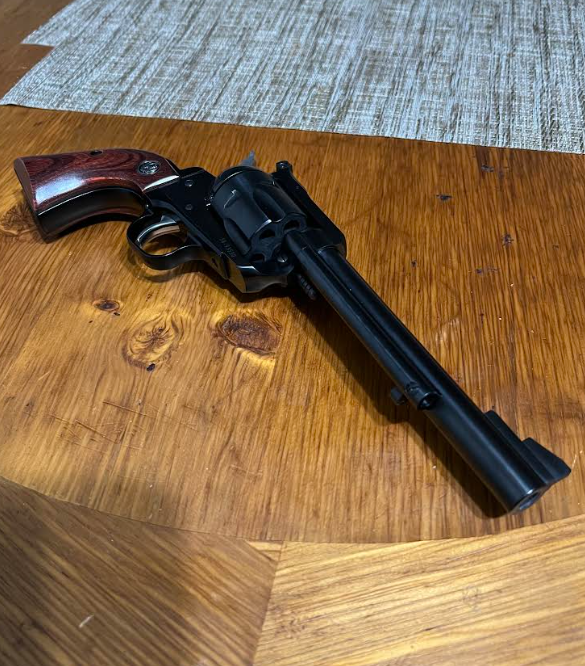
The Ruger Blackhawk in .357 Magnum is a great companion to take out into the woods. In the right hands, it could be an effective self-defense weapon too.
In more recent years, Ruger brought the concept into the modern age with their Blackhawk and Vaquero lines. The Blackhawk is like a stout and modernized Peacemaker that came with adjustable sights and the ability to handle hotter loads. The Vaquero keeps the classic Colt look but it also beefs up the frame and internals for modern safety and durability.
Why Folks Still Own These Guns
There are a lot of these old-style revolvers lying around.
Some were inherited, and others picked up at a gun show or local shop because, frankly, they just look cool. They’ve got soul, character, and history built right in.
Now imagine this. You hear a bump in the night. Maybe you live out in the sticks, maybe not. You reach for the only firearm handy, and it’s a single-action revolver. Not your first choice, sure. But it’s what’s in arm’s reach.
That’s not just a hypothetical for a lot of folks. There are people out there who only own a single-action revolver. Maybe it’s granddad’s old six-shooter, or maybe it’s a Cimarron replica bought for cowboy action shooting. But if that’s what you’ve got, that’s what you’re going to use.
Double Action vs. Single Action
Let’s get into the mechanics a bit. A double-action revolver lets you pull the trigger and fire in one motion. The trigger both cocks the hammer and drops it.
In single-action, the hammer has to be manually cocked before each shot. That means every shot takes two steps: cock the hammer, then pull the trigger.
There’s no question that in a stress-filled situation, a double-action revolver (or better yet, a semi-auto pistol) is faster and much easier to use. You don’t have to think about cocking anything; just point and squeeze. But with training and familiarity, a single-action revolver can still be run surprisingly fast.
With practice, thumbing the hammer becomes second nature. And let’s not forget, the trigger on a single-action is usually crisper and also just a bit lighter than most double-actions. That can help with accuracy under pressure, and especially if you’ve practiced just enough to be confident with it.
Speed and Reloading
Here’s the big kicker: reloading. Single-action revolvers typically use a loading gate and ejector rod system. One round out, one round in.

Guns like this Uberti-made Single Action Army replica in .45 Long Colt are a common presence in the gun world. It’s not out of the question that some may be pressed into service in the event of an SHTF scenario,
It’s slow, no sugar-coating it! You’re not going to be topping off a single-action gun in the middle of a firefight.
But again, context matters. Most home defense shootings are over in just a few rounds. If you’ve got six rounds of .357 Magnum or .45 Colt and you know how to use them, you’re not exactly helpless. And in a rural setting, the odds of a prolonged and multi-assailant shootout are pretty slim.
What You’re Giving Up…and What You’re Gaining
So let’s be honest: a single-action revolver isn’t the ideal choice for self-defense. It’s not fast to reload, it requires two actions to fire, and it usually holds six rounds.
But that doesn’t mean it’s useless.
Here’s what you are getting:
- A reliable firearm that’s simple to maintain
- Powerful cartridges (like .357 Magnum or .45 Colt)
- A light and crisp trigger
- Excellent accuracy with practice
- A very safe mechanism that won’t go off unless deliberately cocked and fired
And in some cases, that might be all a person needs.
When It’s the Only Gun You’ve Got
Let’s not kid ourselves. In a perfect world, everyone would have a high-capacity and low-recoil modern pistol with a weapon light and spare mags. But that’s not always the case.
Sometimes a single-action revolver is all you’ve got. Maybe it’s all you can afford. Maybe it’s all you’re comfortable shooting.
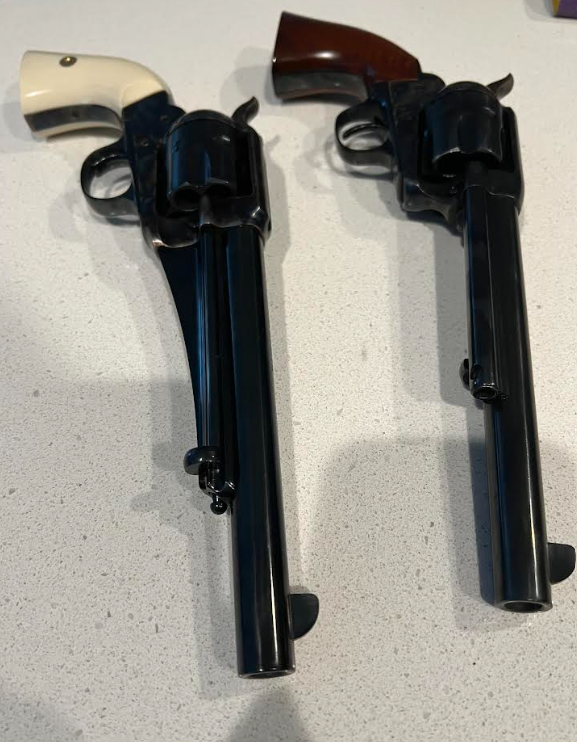
Uberti-made replicas of the Remington Model 1875 and the Colt Single Action Army, both in .45 Long Colt.
And who says that’s always a bad thing? My Ruger Blackhawk in .357 Magnum is one of my favorite guns, and I’d take it into the woods over a polymer 9mm any day. It’s accurate and rugged, and thanks to its caliber it also hits like a freight train. With adjustable sights and the ability to run hot handloads or even .38 Special for practice, it’s also a versatile tool.
If you have an SA revolver, and if you plan on using it, then you owe it to yourself to train with it. Learn to run it efficiently. Know how to reload it. Practice your draw. Be confident in your ability to use it well.
Because when things go bump in the night, the best gun is the one you’ve got on hand…and know how to use.
Final Thoughts
Single-action revolvers aren’t for everyone, and they’re not my first recommendation for defensive use.
But writing them off entirely is a mistake. They’re still reliable and powerful, and they’re also more than capable in the right hands.
If it’s the only gun you’ve got, or even the one you happen to have close when trouble comes knocking, you’re not out of the fight.
Not by a long shot.