There are pocket pistols and there are mouse guns…and then there is the Beretta 950 Jetfire.
This little creature belongs to a class of firearms that manages to be both charming and controversial at the same time. It’s the kind of pistol that disappears into a pocket so completely that the only clue you are carrying it is the slight weight shift when you start walking (literally!).
The Jetfire is small, slick, lightweight, and surprisingly well built for something that looks like it should come with a magnifying glass.
And for what it is meant to be, it excels. A deep concealment tool. A last ditch emergency gun. A firearm someone can always have on their person when larger semi-automatic pistols are impractical. It’s the embodiment of the idea that the gun you have is better than the one you left at home.
But this immediately leads to the big question. Is the .25 ACP cartridge that the Jetfire fires actually adequate for self defense? Or is it just a nostalgic relic that people carry because it is cute, comfortable, or convenient?
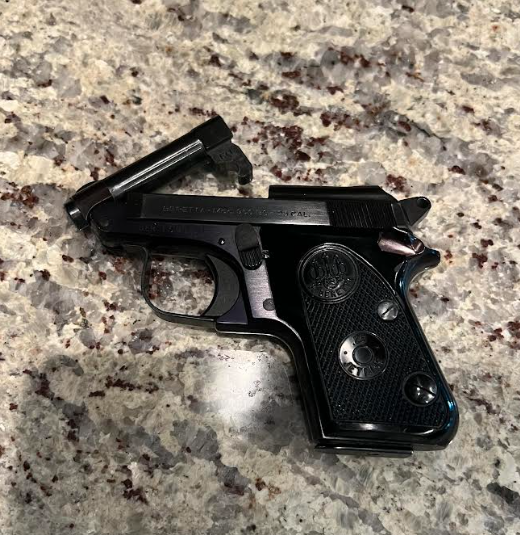
The signature feature of the Beretta Jetfire is its tip-up barrel design, which allows you to load a round without needing to rack the slide.
To answer that, you have to understand both the gun and the cartridge…because the two were designed around each other in a way that makes this whole conversation far more interesting than a simple caliber debate!
The Beretta 950 Jetfire as a Defensive Tool
Beretta built the Jetfire with a purpose, and that purpose was to provide a tiny, reliable, and almost foolproof pistol that anyone could carry.
Where Does the Jetfire Excel?
The tip up barrel design, which is its signature feature, allows loading a round directly into the chamber without ever pulling the slide. This is a huge advantage for people who have limited hand strength or mobility issues. The Jetfire operates in a way that is almost intuitive, and that’s true even for many folks who do not shoot often.
The overall size and weight are the biggest draws. The Jetfire is so small that it hides in any pocket, purse, ankle holster, or even waistband space that would reject a larger gun outright. It is a pistol that you can carry in athletic shorts, sweatpants, or light clothing where a compact 9mm would drag your waistband down like a sack of potatoes.
And despite the diminutive size, Beretta’s workmanship shows. The trigger is workable. The controls are simple. The reliability is surprisingly strong for such a small blowback operated pistol. Many older pocket pistols have a reputation for jamming. I found that the Jetfire does not share that problem when fed decent ammunition.
Where the Jetfire Shows Its Age and Size
Of course, a gun this small is not without drawbacks.
The sights are minimal. The grip is short enough that you might only get one or two fingers on it. Recoil is not painful, but I’ve found that the pistol can shift in the hand if your grip is not secure. Magazine capacity is low. And the safety system is simple, which some will like and others will not.
Still, the Jetfire is exactly what it pretends to be. A tiny, highly concealable backup gun that can be drawn quickly and put into action without mechanical fuss. That leads us straight into the much bigger question.
The .25 ACP as a Self Defense Cartridge
The .25 ACP is one of the most misunderstood cartridges in the defensive world. It often gets mocked, dismissed, or compared to harsh language.
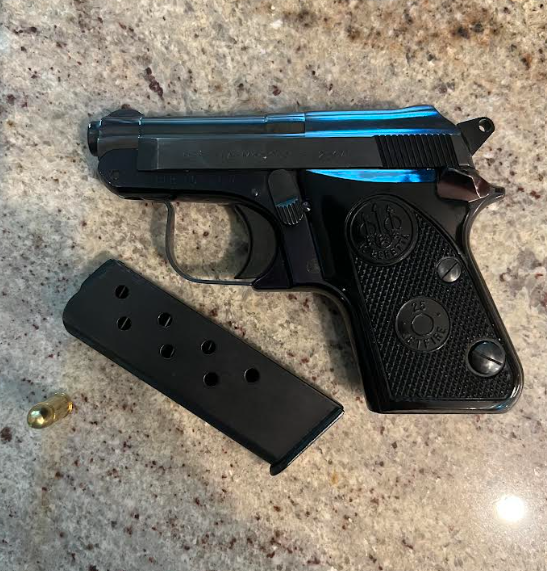
The Jetfire next to a magazine and a single .25 ACP FMJ round. It’s a tiny pistol, so naturally, it fires a tiny round!
But the truth is more complicated, and in several specific scenarios, the .25 ACP has real advantages:
First, reliability in tiny guns
Small semiauto pistols can be finicky with rimfire ammo like .22 LR. Misfires are common, and in a life or death situation, a misfire can ruin everything. The .25 ACP solves this because it is a centerfire cartridge.
Centerfire primers are dramatically more reliable than rimfire ones. This reliability is why many people choose .25 ACP over .22 LR for pocket pistols despite the slightly higher recoil and cost.
Second, penetration is respectable for its size
While not anywhere near the performance of modern hollow point 9mm or even .380 ACP, .25 ACP full metal jacket rounds tend to penetrate consistently.
Many gel tests show penetration around 8 to 12 inches depending on barrel length and load. That is not ideal, but it can reach the vital organs if placed correctly, so don’t be too quick to discount it.
Third, controllability is excellent
A Jetfire recoils like a startled kitten. Follow up shots are lightning fast. Someone who struggles with 9mm recoil may find the .25 ACP far easier to shoot accurately. A gun that allows precise shot placement is far more dangerous than a gun whose recoil overwhelms the shooter.
Fourth, the gun can be carried absolutely everywhere
You are far more likely to have a Jetfire on you than a full size pistol when you are wearing gym clothes, running errands, or if you’re just trying to stay discreet in environments where printing would be an issue.
It’s been said before and I’ll say it again, the .25 in the pocket beats a .45 in the safe every time!
The Limitations of the .25 ACP
As useful as those advantages are, there are real limitations that cannot be ignored:
Stopping power is extremely limited.
The .25 ACP does not produce hydrostatic shock. It does not expand meaningfully. It does not deliver the kind of immediate tissue disruption that modern defensive rounds do.
Many attackers have survived multiple .25 ACP wounds and remained mobile. In defensive shootings, this is a serious concern.
Penetration is borderline
While .25 ACP can reach vital organs with luck and accuracy, it may fail to do so if bone is struck, if the angle is poor, or if the target is large. It’s a cartridge that demands precise shot placement.
Barriers are a major problem
Heavy clothing, thick jackets, or even leather can significantly reduce effectiveness. The .25 is not a cartridge built to punch through obstacles.
Low damage per hit means more hits are needed
This is why the Jetfire’s easy recoil is important, but it is also a reminder that this cartridge is not necessarily meant for one shot stops.
So Why Would Someone Use a .25 ACP for Self Defense?
Because real life does not always allow a shooter to carry what they want. Sometimes they can only carry what fits.
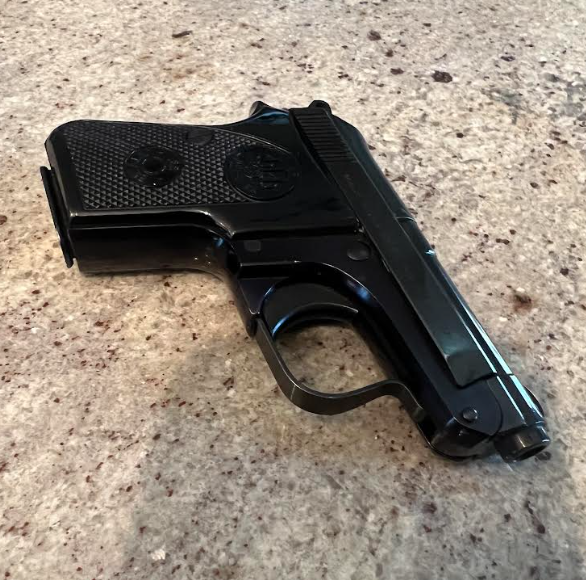
The Jetfire is incredibly easy to conceal, and it manages to look cool while doing it!
The .25 ACP, in a gun like the Jetfire, offers:
- A reliable alternative to .22 LR
- A firearm that even people with weak hands can load and operate
- A pistol so light and compact that you are never tempted to leave it behind
- A round that is easy to control under pressure
- A simple tool for extremely close range defense
- A deep concealment option for situations where anything larger is impossible
Put bluntly, the Jetfire is not carried by people who expect a long distance firefight. It is carried by people who understand that self defense encounters happen at arm’s length, in confined spaces, under surprise conditions.
And that range, the ability to draw quickly and shoot accurately becomes far more important than raw muzzle energy.
The Bottom Line
Caliber discussions aside, the Beretta Jetfire itself is one of the best ultra deep concealment pistols ever made.
It is reliable, intuitive, well built, and small enough that you simply cannot find an excuse not to carry it. As a tool for extreme close quarters emergency defense, it excels.
But the .25 ACP round that it fires is a cartridge of tradeoffs. It brings reliability and controllability to the table, but it sacrifices stopping power. It will not incapacitate as quickly as larger calibers. It requires accuracy, calm under pressure, and awareness of its limitations.
Is it adequate?
In the narrow context of deep concealment, last ditch defense, and extremely close range threats, yes. It can work.
Is it optimal?
No. Many better cartridges exist for people who can carry larger pistols.
The Jetfire is not the gun for the fight you plan for. But it’s the gun for the fight you never saw coming.