I have always had a weakness for oddball guns that most people have never heard of, and the Walther P5 fits that description almost perfectly.
This is not a gun that you see at the range very often. It’s also not a gun that shows up in movies or video games with any regularity. It’s not even a gun that most gun store employees will recognize if you ask about it!
But it is a genuinely interesting pistol with distinctive features, elegant and solid German engineering, and a look that I can only describe as “what if James Bond’s PPK went to the gym and got really into 1970s German industrial design?”
So let’s talk about what makes the Walther P5 interesting, why it looks the way it does, and whether this old German classic still has any relevance in 2026.
The History Most People Do Not Know
The Walther P5 was developed in the 1970s in response to a German police requirement for a modern service pistol.
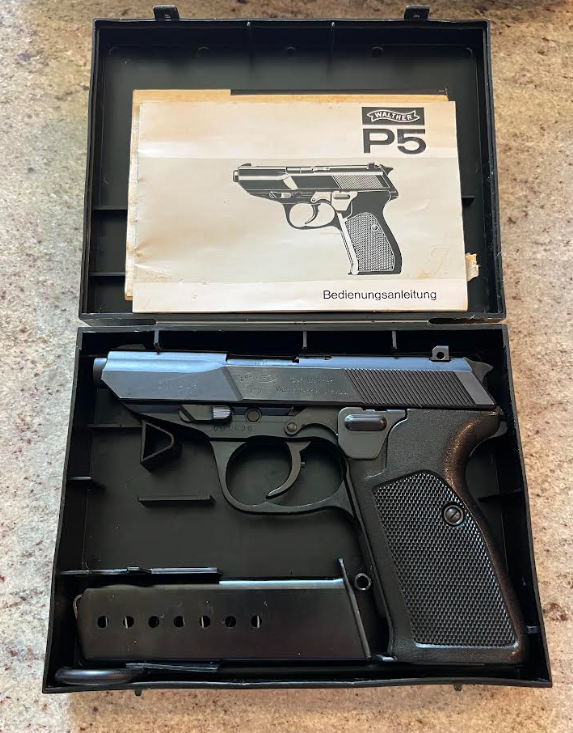
The P5 in its original factory box with the manual and a spare 8-round single stack magazine.
After the terrorist attack at the 1972 Munich Olympics, German law enforcement agencies realized that they needed to upgrade from the aging 7.65mm (.32 ACP) pistols that they were still carrying, many of which dated back to World War II or the immediate post-war period.
Walther responded with the P5, which was introduced in 1977. The design goal was to create a modern 9mm pistol that incorporated lessons learned from earlier Walther designs (particularly the P38) and while meeting the specific requirements German police agencies were demanding.
Those requirements included a hammer-fired double-action/single-action trigger system, a manual safety, a decocker, and a magazine capacity of at least 8 rounds. German police also wanted a gun that could be carried safely with a round in the chamber but that could be quickly brought into action when needed.
The P5 met those requirements, and it was adopted by several German state police agencies, most notably the police in North Rhine-Westphalia. It was also standard issue for Dutch police units and was also reportedly utilized in limited numbers by certain German and UK special forces groups.
Despite being a solid pistol that met its design goals and that found some level of success in Europe, the P5 never achieved widespread success in the United States or elsewhere. It was expensive to manufacture, it came out during a period when other designs like the Sig P-series and Beretta 92-series were gaining traction, and it had some quirky features that did not appeal to the broader market.
Walther discontinued the P5 in 2000 after producing somewhere around 100,000+ units. It was replaced (along with the P88) by the P99, which went in a completely different direction with polymer and striker-fired operation and later led to the PPQ and PDP.
Today, the P5 is a forgotten piece of Cold War firearms history. But it’s a well-made piece of history that still shoots well if you can find one. I loved the one I had!
What Makes the P5 Different
The Walther P5 has two features that immediately stand out to anyone familiar with pistols: the left-side ejection port and the European heel magazine release.
The left-side ejection is unusual because most pistols eject spent casings out the right side of the slide. Walther designed the P5 to eject out the left side. From a shooter’s perspective, left-side ejection is just different. You notice it when you shoot the gun because the brass is flying in an unexpected direction. It does not affect function at all, but it is distinctive and it also immediately tells you that you are shooting something unusual.
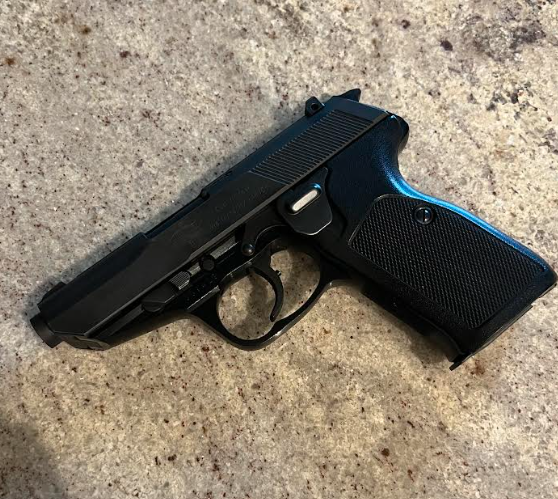
The P5 was a futuristic-looking weapon in the 1970s and remains so today. There truly is no other gun that looks like it.
The heel magazine release is the feature that most modern shooters find frustrating. Instead of a button on the grip that you can press with your thumb, the P5 has a lever at the base of the grip that you pull down to release the magazine. This is the traditional European design that shows up on older guns like the Makarov and various other European pistols from the mid-20th century.
Heel releases are slower than modern button releases. There’s no way around that fact. You cannot drop the magazine with one hand while keeping your firing grip intact. You have to shift your grip, reach to the base of the gun, and pull the lever. It’s awkward if you are used to modern pistols.
But here’s the thing: if you’re not trying to do tactical reloads under stress, it works fine. For casual shooting, for home defense where you are probably not going to need a reload, or for collecting and occasional range use, the heel release is just a quirk rather than a serious limitation.
Let me put it this way, I don’t love heel releases, but I also don’t think that they disqualify the P5 from being a viable defensive pistol if you understand their limitations.
The Look and Feel of the P5
The Walther P5 is a good-looking gun! I will just say that outright. It has clean lines, a high-polish blued finish on most models, and proportions that feel balanced and elegant in a way that modern pistols rarely achieve.
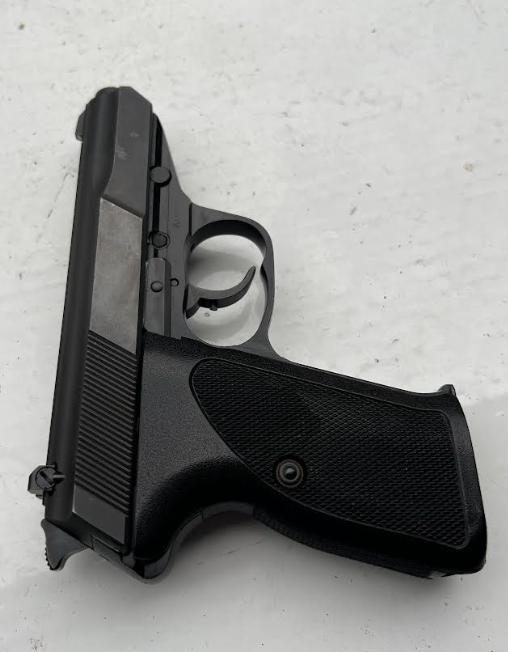
Notice how there’s no slide release on the right side of the P5’s slide like with most pistols? That’s because it’s on the left side of the slide, which you’ll notice in the other photos.
It genuinely does look like a grown-up version of the Walther PPK. The lines are similar and the overall aesthetic is clearly from the same design language, but everything is scaled up and modernized.
It has a space-age quality to it that reflects its 1970s origins…smooth curves, minimal external controls, and a futuristic look that has aged surprisingly well.
In terms of feel, the P5 is more comfortable to shoot. It’s an all-metal gun, so it has weight that helps manage recoil. The double-action trigger pull is long and heavy, as expected, but the single-action pull is decent. The gun points naturally and the sights are adequate for a pistol from this era.
Is the P5 Still Viable for Defense?
Here’s the question that actually matters: if you owned a Walther P5 in 2026, could you use it as a defensive pistol?
My answer is yes, with some caveats.
The P5 is a well-made, reliable 9mm pistol. It holds 8+1 rounds in the standard model, which is not impressive by modern standards but is adequate for most defensive scenarios. The gun is accurate, manageable, and mechanically sound if properly maintained.
The double-action/single-action trigger gives you a heavy first shot and lighter follow-up shots, which some people prefer for safety reasons. The manual safety and decocker allow you to carry the gun with a round chambered and the hammer down, which is a safe and viable carry method.
The main limitation is the heel magazine release, which makes reloads slow. If you are comfortable with that limitation and don’t plan to get into extended gunfights requiring multiple magazine changes, the P5 works fine for home defense or even concealed carry if you can find a holster.
The bigger practical issue is parts availability and gunsmith support. The P5 has been out of production for decades. Parts are not impossible to find, but they are not sitting on shelves at Brownells either. If something breaks, repair might become difficult or expensive.
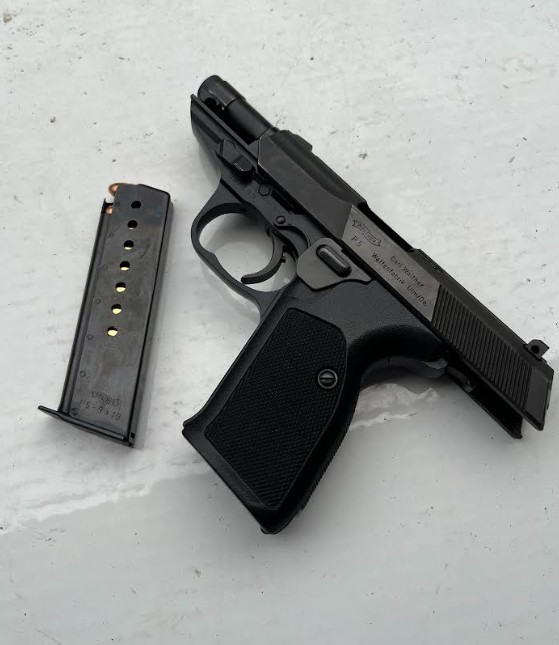
The P5 is a fun gun to shoot at the range. The slide release and decocker lever is one and the same: pushing up allows the slide to lock back like you see in the photo, while moving it downward decocks the pistol.
For those reasons, I would not recommend buying a P5 specifically as a defensive semi-automatic pistol in 2026. There are better, more practical options that are cheaper, easier to maintain, and more ergonomically modern.
But if you already own a P5, or if you buy one primarily as a collector’s item and want the option of using it defensively, it is absolutely capable of that role. This is not a fragile museum piece. It is a real gun that still works!
Conclusion
In short, the P5 is a collectible handgun with genuine shooting capability, a piece of Cold War German design that still works, and an interesting alternative to the usual classic pistols that everyone already knows about.
If that appeals to you, and if you have the budget for a gun that serves more as a hobby piece than a practical tool, the P5 is worth seeking out before prices climb even higher and clean examples become harder to find.